
 Image 1 of 1
Spiritual Spelunking: The Monster, the Treasure, and Me with Mythologist Scott Bryson, PhD
Four Week Class Taught Online Via Zoom
Day of Week , _______, 2026
4:00 - 5:00pm ET (NYC Time) I WOULD SUGGEST NO EARLIER THAN 6PM ET UNLESS A WEEKEND
$___ Paid Patreon Members / $___ General Admission
PLEASE NOTE: Classes will be recorded and archived for students who cannot make that time
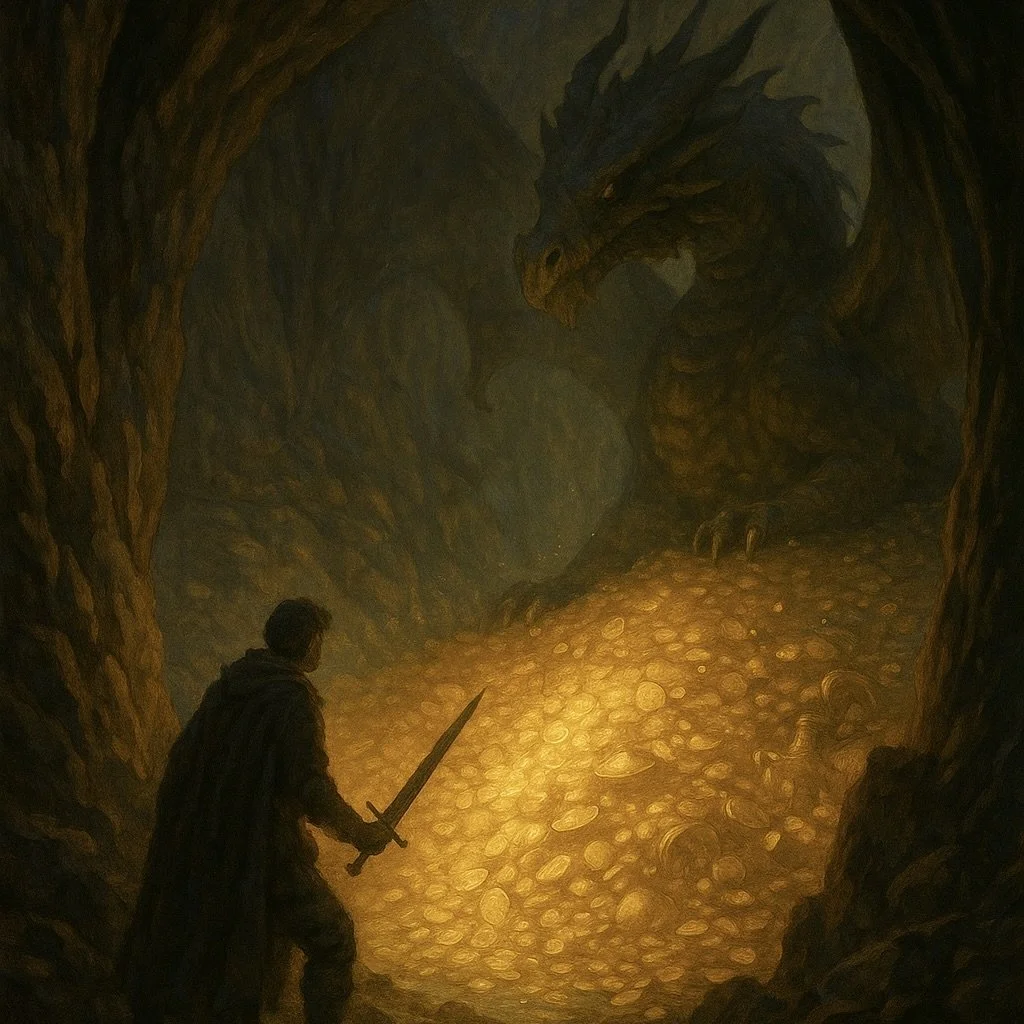
Joseph Campbell said it decades ago: the treasure we most desire is hidden in the cave we most fear. Heroes enter caverns, forests, labyrinths, and underworlds and find, time and again, not punishment, but transformation. This course explores why descent — into darkness, confusion, and the unknown — is essential to psychological and creative life.
We will begin by asking what it means to “go into the dark.” We will explore Campbell’s insight alongside classic descent stories — Persephone, Orpheus, Theseus, Bilbo and Gollum, Tom Sawyer, the Brothers Grimm, and Into the Woods. We consider why cultures insist that wisdom lies off the path, and, drawing on the poet Robert Bly’s take on Jungian shadow work, discuss how we hide pieces of ourselves and how descent begins the work of retrieval.
Next, we will consider how the monster at the cave’s mouth is often a mirror. We will explore Jung’s shadow and how fear, shame, and unresolved memory can take symbolic form. Using psychological readings and folktales, we examine three pathways into the cave: forced descents (crises, loss, rupture), chosen descents (analysis, self-examination, ritual), and mythic descents (using story as a portal to the unconscious), asking why monsters so often guard treasure and what the psyche is trying to protect.
Following, we will focus on the tools descents require. We look at guides in myth and life — mentors, therapists, friends, ancestors — and the small internal signals that mark a “cave entrance.” Emotional overreactions, envy, and defensiveness become clues, and we explore Ariadne’s thread as a model for inner navigation: how to hold onto something steady while wandering unfamiliar territory.
Finally, we will explore how treasure and threat are inseparable; dragons sit on gold for a reason. Pulling together the themes from earlier weeks, we look at how hidden qualities — anger, imagination, grief, confidence, desire — become treasure when reclaimed. We examine folktales where the hero emerges with a magic item, a secret name, or a new identity, and why the return is as essential as the descent, inviting participants to reflect on their own “caves,” the guardians at the door, and what might be waiting to be carried back into daylight.
Scott Bryson, PhD: Author, professor, and mythologist is the author of numerous books and articles and Professor of English at Mount Saint Mary’s University, where he teaches on a wide range of subjects, including U.S. literature, Los Angeles literature, and mythology.
Four Week Class Taught Online Via Zoom
Day of Week , _______, 2026
4:00 - 5:00pm ET (NYC Time) I WOULD SUGGEST NO EARLIER THAN 6PM ET UNLESS A WEEKEND
$___ Paid Patreon Members / $___ General Admission
PLEASE NOTE: Classes will be recorded and archived for students who cannot make that time
Joseph Campbell said it decades ago: the treasure we most desire is hidden in the cave we most fear. Heroes enter caverns, forests, labyrinths, and underworlds and find, time and again, not punishment, but transformation. This course explores why descent — into darkness, confusion, and the unknown — is essential to psychological and creative life.
We will begin by asking what it means to “go into the dark.” We will explore Campbell’s insight alongside classic descent stories — Persephone, Orpheus, Theseus, Bilbo and Gollum, Tom Sawyer, the Brothers Grimm, and Into the Woods. We consider why cultures insist that wisdom lies off the path, and, drawing on the poet Robert Bly’s take on Jungian shadow work, discuss how we hide pieces of ourselves and how descent begins the work of retrieval.
Next, we will consider how the monster at the cave’s mouth is often a mirror. We will explore Jung’s shadow and how fear, shame, and unresolved memory can take symbolic form. Using psychological readings and folktales, we examine three pathways into the cave: forced descents (crises, loss, rupture), chosen descents (analysis, self-examination, ritual), and mythic descents (using story as a portal to the unconscious), asking why monsters so often guard treasure and what the psyche is trying to protect.
Following, we will focus on the tools descents require. We look at guides in myth and life — mentors, therapists, friends, ancestors — and the small internal signals that mark a “cave entrance.” Emotional overreactions, envy, and defensiveness become clues, and we explore Ariadne’s thread as a model for inner navigation: how to hold onto something steady while wandering unfamiliar territory.
Finally, we will explore how treasure and threat are inseparable; dragons sit on gold for a reason. Pulling together the themes from earlier weeks, we look at how hidden qualities — anger, imagination, grief, confidence, desire — become treasure when reclaimed. We examine folktales where the hero emerges with a magic item, a secret name, or a new identity, and why the return is as essential as the descent, inviting participants to reflect on their own “caves,” the guardians at the door, and what might be waiting to be carried back into daylight.
Scott Bryson, PhD: Author, professor, and mythologist is the author of numerous books and articles and Professor of English at Mount Saint Mary’s University, where he teaches on a wide range of subjects, including U.S. literature, Los Angeles literature, and mythology.