
 Image 1 of 1
Playing With Ideas: Drawing Creative Inspiration From the Philosophy of Games with Jonathan Bright, Begins October 8
Five Week Class Taught Online Via Zoom
Thursdays, October 8 - November 5, 2026
7:00 - 9:00pm ET (NYC Time)
$125 Paid Patreon Members / $145 General Admission
PLEASE NOTE: Classes will be recorded and archived for students who cannot make that time
Games are an ancient, ubiquitous, and entrenched aspect of human culture. They can delight us or disturb us, raise our heart rates and line our palms with sweat. They can absorb our attention for minutes or hours, distorting our sense of time and self. They can foster close interpersonal bonds or make us genuinely upset with friends and family.
Yet, despite their familiarity, games can seem utterly pointless. Why do we care so much about where that person kicks that ball? Why bother learning complicated rules about how to move little objects around some colorful cardboard, only to agonize over their positions for a few hours before throwing it all back in the box? How do these arbitrary, ephemeral goals grip us so strongly?
This class will survey ideas from the philosophy of games, a multi-disciplinary field of inquiry raising questions such as:
What are games? Is it even possible to define what makes a game a game?
Why do games matter to us? Are they only instrumentally valuable, or can they be worthwhile for their own sake?
Do games constitute a kind of art? If so, what medium or aesthetic values characterize them
Our purpose in grappling with these questions will not just be intellectual enrichment, but also to spark inspiration for creative projects, games or otherwise. We’ll do this in a few ways:
We will take seriously the idea that games are a kind of art. By closely considering the artistic status of games, we will pursue analogies between games and other art forms to uncover new creative possibilities.
Following an idea from Bernard Suits that any activity can be transformed into a game by imposing the right kind of unnecessary obstacles, together we will reimagine the creation and appreciation of art as activities that can be shaped by selectively adding goals and rules.
We will expose ourselves to a variety of games, both through play and discussion, including games that straddle lines with narrative, commentary, and experimental art.
Through discussion of weekly readings, work on a class project, and playing games both in and outside of class sessions, students will acquire new philosophical concepts from an exciting philosophical subfield and will have the opportunity to connect with others about creative projects in development. This class welcomes anyone interested in learning about the philosophy of games or exploring games as a source of creative stimulus. For class projects, all art forms are welcome. Regardless of whether you would like to work on an existing project, a new project, or no project at all, let’s think hard and have some fun!
Jonathan Bright received his PhD in philosophy from the University of Southern California. He enjoys looking for connections between games, art, puzzles, language, and philosophy.
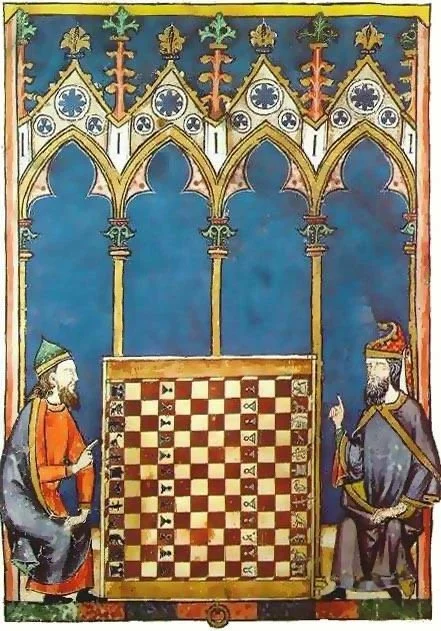
Images: Miniature from Libro de los juegos, 1283 CE;
Five Week Class Taught Online Via Zoom
Thursdays, October 8 - November 5, 2026
7:00 - 9:00pm ET (NYC Time)
$125 Paid Patreon Members / $145 General Admission
PLEASE NOTE: Classes will be recorded and archived for students who cannot make that time
Games are an ancient, ubiquitous, and entrenched aspect of human culture. They can delight us or disturb us, raise our heart rates and line our palms with sweat. They can absorb our attention for minutes or hours, distorting our sense of time and self. They can foster close interpersonal bonds or make us genuinely upset with friends and family.
Yet, despite their familiarity, games can seem utterly pointless. Why do we care so much about where that person kicks that ball? Why bother learning complicated rules about how to move little objects around some colorful cardboard, only to agonize over their positions for a few hours before throwing it all back in the box? How do these arbitrary, ephemeral goals grip us so strongly?
This class will survey ideas from the philosophy of games, a multi-disciplinary field of inquiry raising questions such as:
What are games? Is it even possible to define what makes a game a game?
Why do games matter to us? Are they only instrumentally valuable, or can they be worthwhile for their own sake?
Do games constitute a kind of art? If so, what medium or aesthetic values characterize them
Our purpose in grappling with these questions will not just be intellectual enrichment, but also to spark inspiration for creative projects, games or otherwise. We’ll do this in a few ways:
We will take seriously the idea that games are a kind of art. By closely considering the artistic status of games, we will pursue analogies between games and other art forms to uncover new creative possibilities.
Following an idea from Bernard Suits that any activity can be transformed into a game by imposing the right kind of unnecessary obstacles, together we will reimagine the creation and appreciation of art as activities that can be shaped by selectively adding goals and rules.
We will expose ourselves to a variety of games, both through play and discussion, including games that straddle lines with narrative, commentary, and experimental art.
Through discussion of weekly readings, work on a class project, and playing games both in and outside of class sessions, students will acquire new philosophical concepts from an exciting philosophical subfield and will have the opportunity to connect with others about creative projects in development. This class welcomes anyone interested in learning about the philosophy of games or exploring games as a source of creative stimulus. For class projects, all art forms are welcome. Regardless of whether you would like to work on an existing project, a new project, or no project at all, let’s think hard and have some fun!
Jonathan Bright received his PhD in philosophy from the University of Southern California. He enjoys looking for connections between games, art, puzzles, language, and philosophy.
Images: Miniature from Libro de los juegos, 1283 CE;