
 Image 1 of 1
7pm ET (NYC time)
Monday, June 29, 2026
PLEASE NOTE: Video playback of free events is only available to Patreon members. Become a Member HERE. Ticketholders: A Zoom invite is sent out two hours before the event to the email used at checkout. Please check your spam folder and if not received, emailhello@morbidanatomy.org.
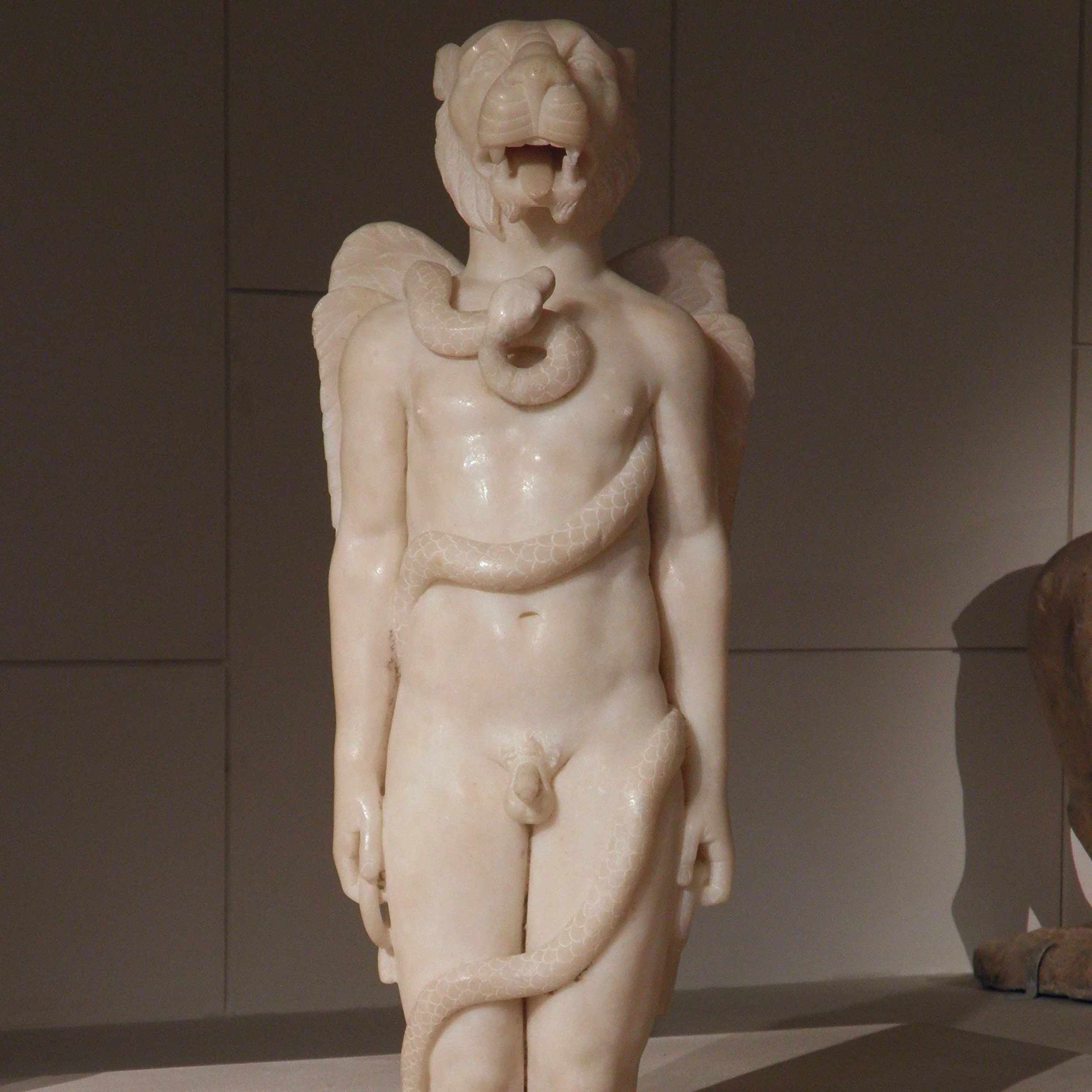
On Christmas Day in 1913, while deeply immersed in his experiments with active imagination, Carl Gustav Jung experienced a visionary metamorphosis: he was transformed into a lion-headed deity encoiled by a serpent. This was the enigmatic figure of Aion, the god of Eternal Time from the ancient Mithraic mysteries. In this lecture, religious studies scholar Dr. Hereward Tilton explores the occultist inspiration of this harrowing experience of ego-death. Above all, the influence of G. R. S. Mead allows us to accurately situate Jung’s work within the Western gnostic traditions, which have long cultivated lucid states via practices akin to active imagination (such as scrying, the subject of Hereward’s upcoming class). Tracing the historical origins of Jung’s vision as well as the psychonautic techniques which gave rise to it, we’ll uncover Aion’s contribution to Jung’s nascent understanding of individuation – a process he described as a “circumambulation of the self.” As he amplified his visionary material in the Red Book and his late work Aion, Jung sought to uncover the relation of individual to collective individuation and the coming of the Aquarian Age. What relevance do his ideas on this subject have to the shifting tides of power and consciousness in the world today?
Hereward Tilton is a religious studies scholar specialising in Rosicrucian history, psychedelic magic, and Jung’s gnostic heritage. He has taught on Western esotericism at the Universities of Amsterdam and Exeter, and his publications include The Quest for the Phoenix (a historical study of early Rosicrucianism); Touch Me Not: A Most Rare Compendium of the Whole Magical Art (a translation of an early modern Austrian black magical manuscript dealing with psychoactive fumigations); and The Path of the Serpent, Vol. 1: Psychedelics and the Neuropsychology of Gnosis (an exploration of gnostic serpent symbolism in light of recent discoveries in psychedelic neuroscience).
7pm ET (NYC time)
Monday, June 29, 2026
PLEASE NOTE: Video playback of free events is only available to Patreon members. Become a Member HERE. Ticketholders: A Zoom invite is sent out two hours before the event to the email used at checkout. Please check your spam folder and if not received, emailhello@morbidanatomy.org.
On Christmas Day in 1913, while deeply immersed in his experiments with active imagination, Carl Gustav Jung experienced a visionary metamorphosis: he was transformed into a lion-headed deity encoiled by a serpent. This was the enigmatic figure of Aion, the god of Eternal Time from the ancient Mithraic mysteries. In this lecture, religious studies scholar Dr. Hereward Tilton explores the occultist inspiration of this harrowing experience of ego-death. Above all, the influence of G. R. S. Mead allows us to accurately situate Jung’s work within the Western gnostic traditions, which have long cultivated lucid states via practices akin to active imagination (such as scrying, the subject of Hereward’s upcoming class). Tracing the historical origins of Jung’s vision as well as the psychonautic techniques which gave rise to it, we’ll uncover Aion’s contribution to Jung’s nascent understanding of individuation – a process he described as a “circumambulation of the self.” As he amplified his visionary material in the Red Book and his late work Aion, Jung sought to uncover the relation of individual to collective individuation and the coming of the Aquarian Age. What relevance do his ideas on this subject have to the shifting tides of power and consciousness in the world today?
Hereward Tilton is a religious studies scholar specialising in Rosicrucian history, psychedelic magic, and Jung’s gnostic heritage. He has taught on Western esotericism at the Universities of Amsterdam and Exeter, and his publications include The Quest for the Phoenix (a historical study of early Rosicrucianism); Touch Me Not: A Most Rare Compendium of the Whole Magical Art (a translation of an early modern Austrian black magical manuscript dealing with psychoactive fumigations); and The Path of the Serpent, Vol. 1: Psychedelics and the Neuropsychology of Gnosis (an exploration of gnostic serpent symbolism in light of recent discoveries in psychedelic neuroscience).