
 Image 1 of 1
Online Talk · Exploring Cabinets of Curiosity: Art, Science, Colonialism, and Cataloguing the Natural World with Artist Kate Samworth
7pm ET (NYC time)
Monday, August 24, 2026
PLEASE NOTE: A link to a recording of this talk will be sent out to ticket holders after its conclusion. It will also be archived for our Patreon members. Become a Member HERE.
Ticket holders: A Zoom invite is sent out two hours before the event to the email used at checkout. Please check your spam folder and if not received, email hello@morbidanayomy.org. A temporary streaming link will be emailed after the event concludes.
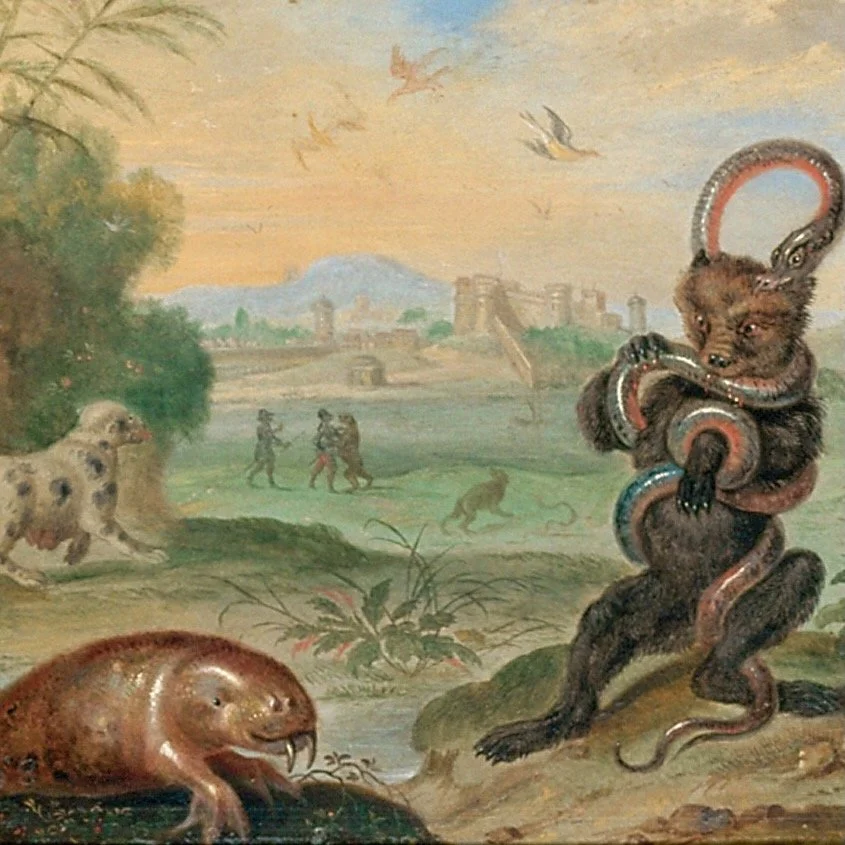
Gallstones, narwhal tusks, and conjoined sheep might be found alongside a saint’s tooth, a sextant, and a ceremonial cup in a Renaissance cabinet of curiosities. Frenzied collecting of natural and man-made objects became a primary occupation of 16th-century nobility, merchants, apothecaries, and natural philosophers.
They and their agents scoured local landscapes, ports, and distant continents for animal, mineral, and vegetal specimens in any form: dead or alive; pickled, stuffed, dried; whole or partial; real or fake. Equally prized were emblems of human capabilities, customs, cultures, and spirituality, such as religious relics, ancient coins, crafts, costumes, scientific tools, and ceremonial objects.
These agglomerations—the precursors of modern museums—soon outgrew cabinets and filled entire rooms or wings, sometimes extending into botanical gardens and menageries at universities and castles across Europe.
For some, such collections displayed wealth, access, taste, and intellect and provided spaces for discussion and entertainment; for others, they offered opportunities for spiritual contemplation. Natural philosophers used them to study connections between organic beings and to find order in the natural world, helping to lay the foundations of modern science.
In this brief introduction to the art of natural history, we will explore how the spice trade, the Greco-Arabic translation movement, and the printing press shaped Renaissance artists and scientists, and how images of the era reveal their scientific, artistic, social, political, economic, and religious motives—as well as the challenges they faced in sorting fact from fiction.
Kate Samworth is an artist/illustrator and educator (RISD, Peabody Museum of Natural History, PA Academy of the Fine Arts, and more). Her work has been exhibited around the country and appeared in multiple magazines. She has illustrated a number of books for children and adults (including her own Kirkus Prize winning Aviary Wonders Inc. and the NYT best-seller Why Fish Don't Exist by Radio Lab host Lulu Miller).
Her artwork is inspired by observing micro and macro changes to the natural world and reflects her interest in folktales and surrealism. She works primarily on scratchboard, which involves removing a layer of black ink to reveal the white clay beneath. The choice of medium allows for delicate lines and precise details and is related to her background in printmaking.
She is represented by Le Mieux Gallery in New Orleans, LA. Info on her art, prints, and classes can be found at katesamworth.com
7pm ET (NYC time)
Monday, August 24, 2026
PLEASE NOTE: A link to a recording of this talk will be sent out to ticket holders after its conclusion. It will also be archived for our Patreon members. Become a Member HERE.
Ticket holders: A Zoom invite is sent out two hours before the event to the email used at checkout. Please check your spam folder and if not received, email hello@morbidanayomy.org. A temporary streaming link will be emailed after the event concludes.
Gallstones, narwhal tusks, and conjoined sheep might be found alongside a saint’s tooth, a sextant, and a ceremonial cup in a Renaissance cabinet of curiosities. Frenzied collecting of natural and man-made objects became a primary occupation of 16th-century nobility, merchants, apothecaries, and natural philosophers.
They and their agents scoured local landscapes, ports, and distant continents for animal, mineral, and vegetal specimens in any form: dead or alive; pickled, stuffed, dried; whole or partial; real or fake. Equally prized were emblems of human capabilities, customs, cultures, and spirituality, such as religious relics, ancient coins, crafts, costumes, scientific tools, and ceremonial objects.
These agglomerations—the precursors of modern museums—soon outgrew cabinets and filled entire rooms or wings, sometimes extending into botanical gardens and menageries at universities and castles across Europe.
For some, such collections displayed wealth, access, taste, and intellect and provided spaces for discussion and entertainment; for others, they offered opportunities for spiritual contemplation. Natural philosophers used them to study connections between organic beings and to find order in the natural world, helping to lay the foundations of modern science.
In this brief introduction to the art of natural history, we will explore how the spice trade, the Greco-Arabic translation movement, and the printing press shaped Renaissance artists and scientists, and how images of the era reveal their scientific, artistic, social, political, economic, and religious motives—as well as the challenges they faced in sorting fact from fiction.
Kate Samworth is an artist/illustrator and educator (RISD, Peabody Museum of Natural History, PA Academy of the Fine Arts, and more). Her work has been exhibited around the country and appeared in multiple magazines. She has illustrated a number of books for children and adults (including her own Kirkus Prize winning Aviary Wonders Inc. and the NYT best-seller Why Fish Don't Exist by Radio Lab host Lulu Miller).
Her artwork is inspired by observing micro and macro changes to the natural world and reflects her interest in folktales and surrealism. She works primarily on scratchboard, which involves removing a layer of black ink to reveal the white clay beneath. The choice of medium allows for delicate lines and precise details and is related to her background in printmaking.
She is represented by Le Mieux Gallery in New Orleans, LA. Info on her art, prints, and classes can be found at katesamworth.com