
 Image 1 of 1
6pm ET (NYC time)
Monday, March 30, 2026
PLEASE NOTE: A link to a recording of this talk will be sent out to ticket holders after its conclusion. It will also be archived for our Patreon members. Become a Member HERE.
Ticketholders: A Zoom invite is sent out two hours before the event to the email used at checkout. Please check your spam folder and if not received, email hello@morbidanayomy.org. A temporary streaming link will be emailed after the event concludes.
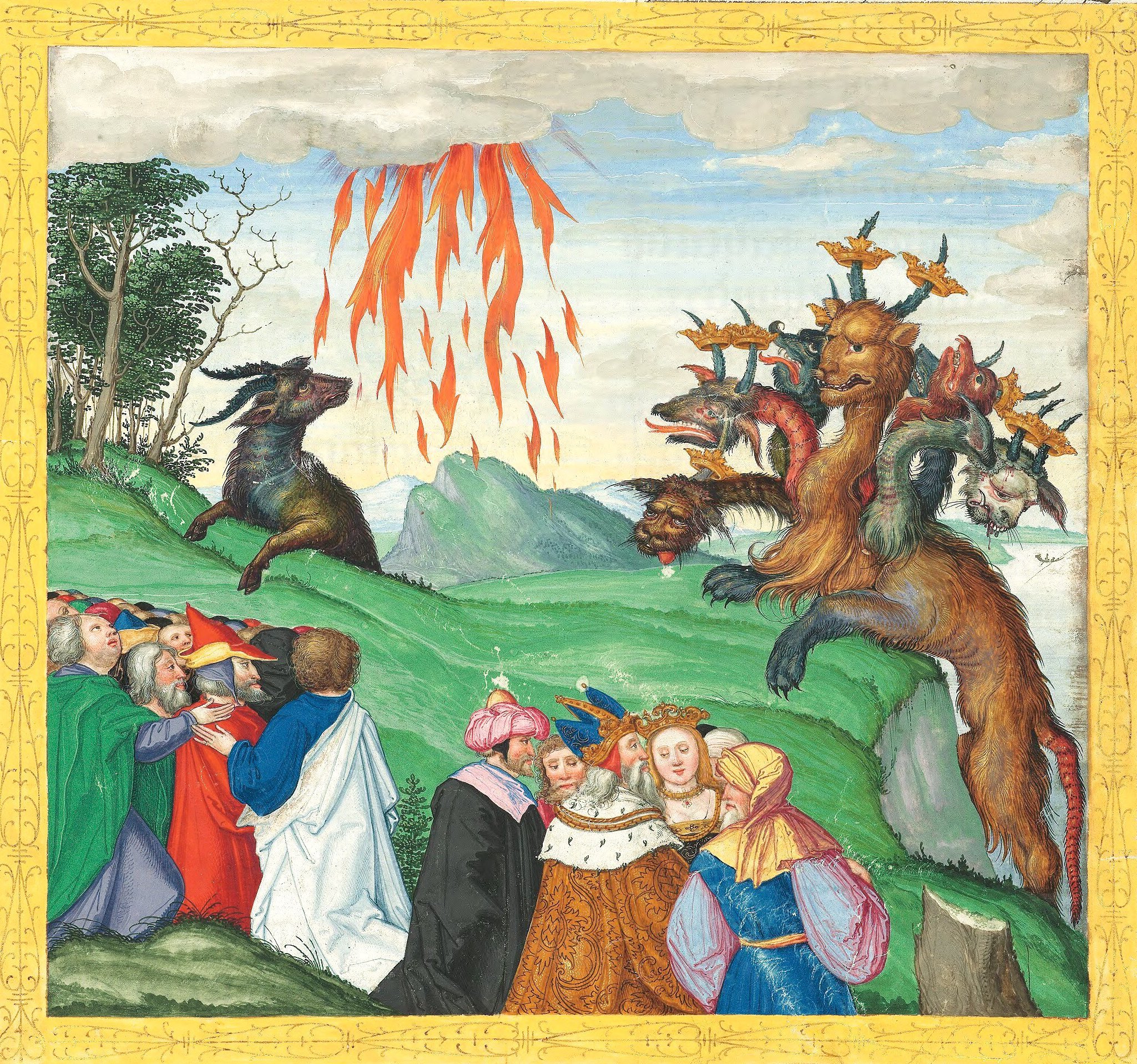
John of Patmos wrote Revelation in the second century CE, during a particularly turbulent period. From his exile in Greece, he recorded his visions, which dealt with the destiny of humankind. After a great cosmic battle, society would transcend toward another, purer stage. However, this kind of collective transmutation would only take place after many catastrophes and sufferings, unfolding in a liminal space-time: a kind of threshold from which the future could be reconstructed.
Today we live in a moment in which the Apocalypse is frequently invoked. But it is not enough to invoke it: it is necessary to re-narrate it. To return to these visions and linger on their images, imagining possible futures. In this talk, art historian María Pandiello—author of the new book Apocalypse: Revelations, Fears, and Possible Futures—will propose the liminal experience of the Apocalypse as a space of collective construction and as a response to catastrophism. She will follow certain historical figures in their relationship to apocalyptic thought: pseudo-prophets, messiahs, omens, monstrosities, and tides of social change.
María Pandiello (Donostia, 1981) holds a degree in Romance Philology and PhD in Art History. Her research focuses on manuscripts and printed books from the fifteenth and sixteenth centuries. Through them, she studies the circulation of ideological currents and artistic expressions across European courts. She has written on semiotics, on artistic and intellectual exchange through books and images, on the political value of libraries, on the role on women in the Medieval political context, and on the use of images from an anthropological perspective.
Her doctoral thesis received an honorary mention from the Portuguese Institute of Art History, and since then she has combined academic research with public outreach, sharing her work through the Visions of Manuscripts project on social media. She has taken part in international conferences and has taught at various cultural institutions and museums, emphasizing the importance of visual heritage as a vehicle for ideological and symbolic meaning. She published “Visions of Fire: An Illustrated History of Alchemy" (2022) and "Apocalypse: Revelations, Fears, and Possible Futures" (2025).
6pm ET (NYC time)
Monday, March 30, 2026
PLEASE NOTE: A link to a recording of this talk will be sent out to ticket holders after its conclusion. It will also be archived for our Patreon members. Become a Member HERE.
Ticketholders: A Zoom invite is sent out two hours before the event to the email used at checkout. Please check your spam folder and if not received, email hello@morbidanayomy.org. A temporary streaming link will be emailed after the event concludes.
John of Patmos wrote Revelation in the second century CE, during a particularly turbulent period. From his exile in Greece, he recorded his visions, which dealt with the destiny of humankind. After a great cosmic battle, society would transcend toward another, purer stage. However, this kind of collective transmutation would only take place after many catastrophes and sufferings, unfolding in a liminal space-time: a kind of threshold from which the future could be reconstructed.
Today we live in a moment in which the Apocalypse is frequently invoked. But it is not enough to invoke it: it is necessary to re-narrate it. To return to these visions and linger on their images, imagining possible futures. In this talk, art historian María Pandiello—author of the new book Apocalypse: Revelations, Fears, and Possible Futures—will propose the liminal experience of the Apocalypse as a space of collective construction and as a response to catastrophism. She will follow certain historical figures in their relationship to apocalyptic thought: pseudo-prophets, messiahs, omens, monstrosities, and tides of social change.
María Pandiello (Donostia, 1981) holds a degree in Romance Philology and PhD in Art History. Her research focuses on manuscripts and printed books from the fifteenth and sixteenth centuries. Through them, she studies the circulation of ideological currents and artistic expressions across European courts. She has written on semiotics, on artistic and intellectual exchange through books and images, on the political value of libraries, on the role on women in the Medieval political context, and on the use of images from an anthropological perspective.
Her doctoral thesis received an honorary mention from the Portuguese Institute of Art History, and since then she has combined academic research with public outreach, sharing her work through the Visions of Manuscripts project on social media. She has taken part in international conferences and has taught at various cultural institutions and museums, emphasizing the importance of visual heritage as a vehicle for ideological and symbolic meaning. She published “Visions of Fire: An Illustrated History of Alchemy" (2022) and "Apocalypse: Revelations, Fears, and Possible Futures" (2025).